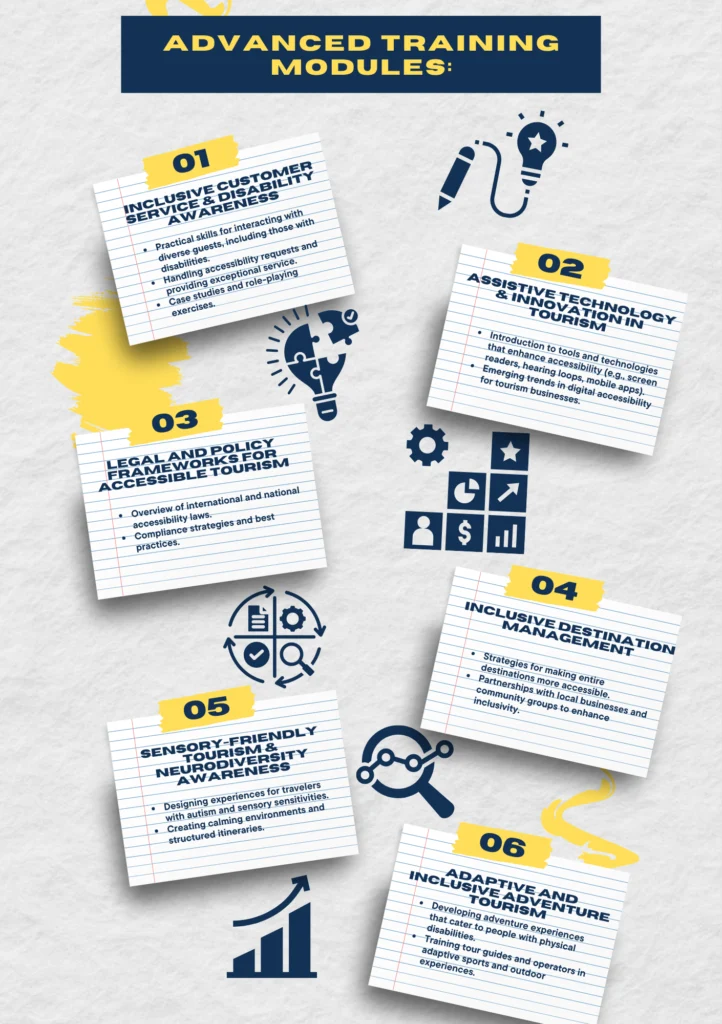
Advanced Training Modules
Inclusive Customer Service & Disability Awareness
Give your team the skills and confidence to welcome every guest. We cover person-first language, visible and non-visible disabilities, service best practice across the full guest journey, and real-world scenario training for reception, F&B, housekeeping, activities, and tours.
Assistive Technology & Innovation in Tourism
Discover practical tools that remove barriers: mobile wayfinding, hearing augmentation, visual communication aids, accessible booking flows, and room/venue technologies. We help you assess, pilot, and implement the right solutions for your operation and budget.
Legal and Policy Frameworks for Accessible Tourism
Understand the key legislation and standards that affect Irish tourism businesses, and translate them into clear internal policies, staff procedures, and measurable KPIs. We also provide template policies and checklists you can adapt and adopt.
Inclusive Destination Management
Design destination-wide accessibility strategies, from transport and signage to digital wayfinding and information provision. Ideal for DMOs, local authorities, and multi-site attractions aiming for consistent, inclusive standards.
Sensory-Friendly Tourism & Neurodiversity Awareness
Create welcoming experiences for autistic and neurodivergent visitors: sensory maps, quiet zones, visual schedules, low-stimulus hours, and staff communication techniques that reduce anxiety and improve satisfaction.
Adaptive & Inclusive Adventure Tourism
Make outdoor and adventure offerings more accessible—trail grading, adaptive equipment options, risk assessment, guide training, and emergency planning—without compromising safety or thrill.
Funding: Up to 90% Support (to €20,000/yr)
Work Access Grants provide financial support to businesses in Ireland to improve workplace accessibility and inclusivity. Eligible costs include staff training, assistive technology, and workplace adaptations—which means you can use this funding to cover our Tourism for All programmes.
- Coverage: Up to 90% of eligible costs
- Cap: Up to €20,000 per year
- Use it for: Accredited training, accessibility audits, technology pilots, policy development
Note: Criteria and availability can change. We’ll help you prepare documentation so you can apply with confidence.
Additional Services
- Certification & Accreditation Programmes
- Customised Staff Training & Workshops
- Marketing & Promotion of Accessible Tourism (storytelling, listings, content)
- Research & Data on Accessible Tourism Trends (surveys, insights, impact)
- Accessibility Audits & Consultations (physical, digital, operational)
Certification & Accreditation: Tourism for All Seals
We’re proud to introduce Ireland’s premier tourism accessibility accreditation—the Tourism for All Gold, Platinum, and Diamond Standard Seals. These recognise hotels, attractions, and destinations that demonstrate excellence in inclusive tourism through staff training, policy development, and continuous improvement (all delivered by us).
As the national benchmark for accessibility, our accreditation is also the qualifying standard for inclusion in the Purple Book, an exciting new initiative we’re proud to support—helping travellers quickly find verified accessible stays and experiences.
How accreditation works
- Baseline audit & roadmap (physical, digital, service)
- Targeted training mapped to identified gaps
- Policy, SOPs, & assistive tech implementation
- Verification & award (Gold, Platinum, or Diamond)
- Annual review to maintain or progress your seal
- Promotion via the Purple Book and marketing support
What you gain
- Independent recognition and trust signals
- Stronger guest reviews and repeat bookings
- Reduced risk through documented compliance
- Staff confidence and consistent guest experience
- Visibility in the Purple Book and partner channels
Who Is This For?
- Hotels, guesthouses, self-catering, hostels
- Visitor attractions, museums, heritage sites
- Tour operators, adventure providers, transport & venues
- DMOs, local authorities, and campus/estate managers
Getting Started (Simple 3-Step Path)
- Discovery call (free): Share goals, timelines, and funding opportunities
- Audit + plan: We assess your current state and produce a costed roadmap
- Deliver + accredit: Training, improvements, verification, and promotion
Ready to lead on accessibility?
Speak to our team about funded training and the Tourism for All accreditation pathway.
FAQs
What is accessible tourism?
Accessible tourism ensures that people with disabilities and varying needs can enjoy travel experiences equitably—from booking and arrival to activities and departure.
Are your courses accredited?
Yes. Our fully accredited courses align with recognised standards and are eligible for 90% grant coverage up to €20,000 per year (subject to scheme criteria).
Do you audit both physical and digital accessibility?
We audit buildings, routes, rooms, signage, and facilities as well as websites, booking flows, content, and communications—plus staff service delivery.
How long does accreditation take?
Most organisations complete the journey in 8–16 weeks, depending on scope and readiness. We can phase delivery around your operations.
What’s the difference between Gold, Platinum, and Diamond?
Each level reflects the depth and consistency of inclusive practice across environment, operations, training, and policy, verified by our assessors.
Can we use funding for technology or adaptations?
Yes—eligible assistive technology and workplace adaptations can be included under the funding guidelines, alongside training and audits.